Epoxy vs. polyaspartic: compare the whole system.
Look at the product layers, use, and installation conditions rather than a single material label.
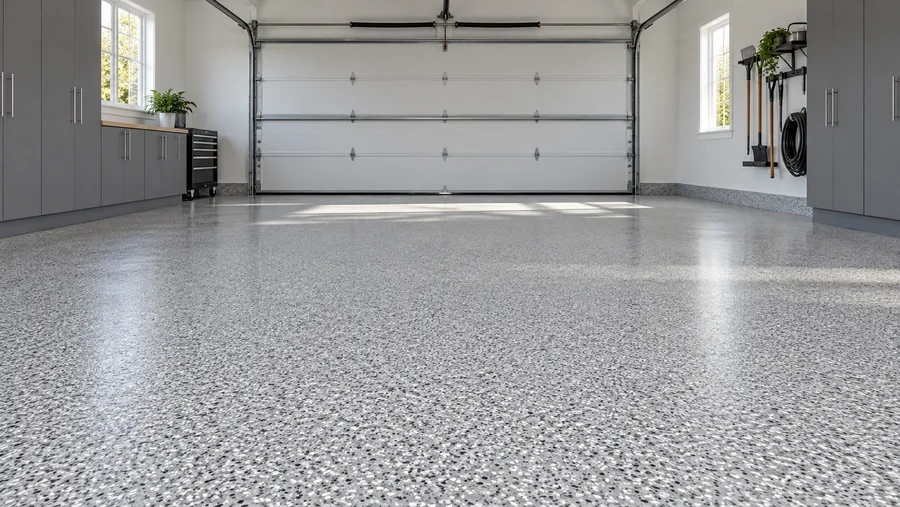
Start with the layer schedule
Ask the installer to identify the primer or base, decorative layer, and topcoat. Some garage systems combine an epoxy base with a polyaspartic finish; other systems use different combinations. The meaningful comparison is the full specification and its suitability for the concrete and intended use.
Compare practical outcomes
Discuss sunlight at the doorway, tire marking, traction, cleaning, appearance, and return-to-service requirements. Performance depends on the exact formulation and application. Broad claims such as “stronger than epoxy” do not explain the test conditions or establish which system is right for your floor.
Ask what happens underneath
Preparation, contamination, moisture, and concrete movement can affect a coating regardless of its chemistry. Confirm how those conditions will be assessed and addressed. Request the manufacturer information for the actual proposed products, not a generic category description.
Read the written limits
Review warranty exclusions, compatible cleaners, and maintenance instructions. Ask whether any condition on your floor falls outside the product requirements. Keep the product names and specification with your project records.
Technical background: Sherwin-Williams on resinous floor preparation and Sika product guidance for a polyaspartic finish. These links are background, not a product endorsement or an installation specification.
Tell us about your floor.
Start with the size, the condition, and the way you want to use the space.